
What Evidence Will You Need?
A medical negligence claim needs three kinds of evidence: your complete medical records, independent expert opinion on whether the care fell below standard and whether that changed the outcome, and proof of the harm and financial losses you have suffered. Your solicitor obtains most of it, you are not expected to build a case yourself.
The evidence has to prove two separate things
Almost every question about evidence becomes clearer once you know what it is for. A claim must establish two things independently, and each needs its own evidence:
Breach — that the care fell below the standard of a reasonably competent professional.
Causation — that the failing actually changed the outcome, rather than the same harm happening anyway.
What a claim relies on
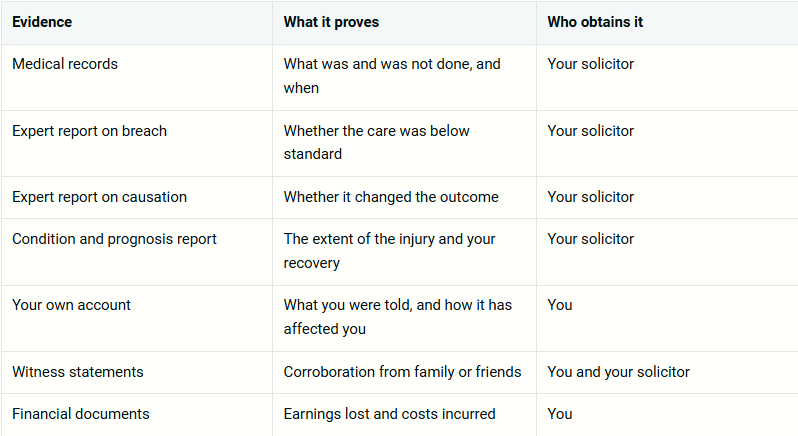
Medical records: the foundation of every claim
The records are the single most important source of evidence, because they are contemporaneous — written at the time, usually without any thought of a claim. A full set can include GP notes, hospital and nursing records, referral letters, test and imaging results, operation notes, anaesthetic charts, prescribing records, midwifery notes and correspondence between clinicians.
You have a right to your own records under UK GDPR. A request for access is free, and the provider should normally respond within one month. In practice your solicitor will request the complete set on your behalf, because partial records taken out of sequence can be misleading and a claim needs everything, including material you would not think to ask for.
Independent expert evidence
Records show what happened. They cannot say whether it was acceptable. That requires opinion from an independent specialist in the same field as the clinician who treated you — someone with no connection to the organisation involved.
Most claims need at least two, sometimes three, expert reports:
Breach of duty - A specialist in the relevant field gives an opinion on whether the care fell below the standard of a reasonably competent professional at the time.
Causation - Often a different specialist, addressing what would probably have happened had the care been adequate. This is a separate question and is dealt with separately.
Condition and prognosis - Once liability looks arguable, an expert examines you and reports on the extent of your injury, your treatment needs and your long-term outlook. This is what the value of a claim is built on.
Evidence of harm and financial loss
Compensation is intended to reflect actual losses, and each element needs backing up. Useful documents include:
Payslips, contracts and accounts, where you have lost earnings or been unable to work
Receipts and invoices for treatment, prescriptions, travel, equipment or adaptations
A record of care and help you have needed from family, hours and tasks, which can be claimed even though nobody was paid
Photographs, where an injury or a scar is visible
Correspondence, complaint responses, Duty of Candour letters and any inquest documents
Four things worth doing now
Write down what happened while it is fresh - Dates, names, symptoms, what you were told, and what you were not told. Detail fades quickly.
Keep everything - Appointment letters, discharge summaries, prescriptions, texts and emails, and any complaint correspondence.
Start a simple diary - A few lines a week on pain, mobility, work, sleep and the help you have needed from others.
Get advice before the time limit gets close - Gathering records and expert opinion takes months.
What if records are missing or wrong?
It happens, and it is not necessarily the end of a claim. Notes can be incomplete, illegible, filed elsewhere or, occasionally, genuinely lost. Where records are missing, a court can draw conclusions from the gap itself, and evidence can be reconstructed from other sources - referral letters, imaging held separately, correspondence, and witness accounts.
If you believe an entry is inaccurate, you can ask the provider to add a correction. You cannot have the original removed, and you should not want to: an amended record with your comment recorded alongside it is stronger evidence than a clean one.