
How a Medical Negligence Claim Works, Stage by Stage
A medical negligence claim runs through seven stages: an initial assessment, a funding agreement, gathering your medical records, obtaining independent expert evidence, sending a formal Letter of Claim, valuing the claim, and negotiating a settlement. Court proceedings are the exception rather than the rule - most claims settle without a trial.
The seven stages
The first conversation - You describe what happened. A solicitor asks about dates, treatment, what you were told and how it has affected you, then gives an honest view on whether it is worth investigating and whether you are within the time limit.
This costs nothing and commits you to nothing. If we think a claim is unlikely to succeed, we will say so at this point rather than later.
Funding is put in place - If the case is worth investigating, a Conditional Fee Agreement - a no win, no fee arrangement is usually set up, along with insurance protecting you against the other side's costs if the claim does not succeed.
If the claim succeeds, a success fee is deducted from your compensation. Under LASPO 2012 that fee is capped at 25% of general damages and past financial losses, and cannot be taken from damages for future care or loss. The exact figure is explained and agreed in writing before you sign anything.
Your medical records are obtained - We request the complete set from every provider involved - GP, hospital, imaging, nursing notes, prescribing records and review them against your account of events. Providers do not always respond promptly, which is one of the more common causes of delay early on.
You do not need to obtain anything yourself.
Independent experts give their opinion - A specialist in the same field as the clinician who treated you reports on whether the care fell below a reasonable standard. A second expert usually addresses whether that failing changed the outcome, a separate question, and often the harder one.
This is the decision point. If the experts do not support the claim it will not proceed, and you will not be charged for the work done.
The Letter of Claim is sent - Under the Pre-Action Protocol for the Resolution of Clinical Disputes, a formal letter sets out the allegations, the harm caused and the basis of the claim. The defendant, often NHS Resolution acting for a trust, then has four months to investigate and reply.
Their Letter of Response will admit liability, deny it, or admit part of it. A denial is not the end: it is common, and it moves the claim into negotiation or, if necessary, proceedings.
The claim is valued - Once liability is admitted or looks strong, a medical expert examines you and reports on your injury, treatment needs and long-term outlook. Alongside this, a schedule of your financial losses is prepared, earnings, care, treatment, equipment and future costs.
Where you are facing immediate financial pressure, an interim payment can sometimes be requested before the claim concludes.
Settlement is negotiated - Most claims end here, through correspondence, a round-table meeting or formal offers. Nothing is agreed without your instructions, you decide whether to accept, and we advise on whether an offer is reasonable.
Where the claim is for a child or someone who lacks capacity, a court must approve the settlement before it can take effect.
What if it goes to court?
Court proceedings are issued in a minority of claims usually where liability is denied, where the parties are far apart on value, or where a time limit needs protecting while investigations continue.
Issuing proceedings is not the same as going to trial. It sets a timetable that both sides must follow: evidence is exchanged, experts on each side discuss their differences and produce a joint statement, and a trial date is fixed. That structure very often produces a settlement, and the large majority of issued claims still resolve before any hearing.
If a case does reach trial, you may be asked to give evidence about your own experience. You would be prepared for it thoroughly, and you would not be expected to argue the medicine, that is what the experts
How long does it take?
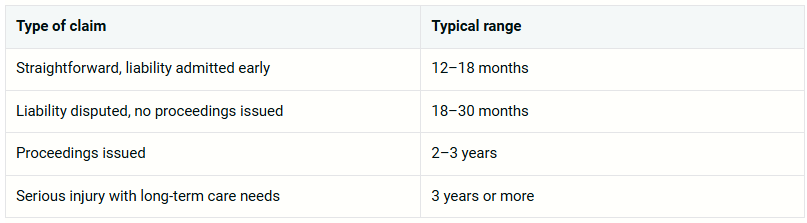
There is no fixed answer, because the timetable depends on the complexity of the case, how quickly records arrive, expert availability, and whether liability is admitted or fought. The ranges below are indicative only and are not a prediction for any individual claim.
What you have to do
Less than most people expect. Your involvement is usually limited to:
An initial conversation, and giving a detailed account of what happened
Signing the funding agreement and authority forms for your records
Attending one or more medical appointments for expert reports
Providing documents that evidence your financial losses
Giving instructions on offers - the decisions are yours, not ours
Between those points there are often quiet stretches of weeks or months while records are chased or experts prepare reports. Silence usually means the process is running normally, but you are entitled to ask for an update at any time.